Side B: tools
Lead filter. A bouncer for messages that come in through a website: only people who really want something get in.
building · internal use · reading time
Someone used to check every request one by one. Now the filter weeds out the spam and unwanted requests by itself. And the ones that do get through often arrive as a jumble. The filter turns them into plain, readable text, so a colleague can check the doubtful cases quickly. That saves us hours of work. I made it purely for internal use, tailored to one system.
Why I built the lead filter
A quote site gets requests every day. Someone wants a new roof, a different boiler or a fresh bathroom. But mixed in with them is all sorts of stuff that doesn’t belong: advertising, test messages, keyboard mashing, messages in a different alphabet. A classic: agencies offering their SEO services. As an SEO specialist myself, I find that a little embarrassing.
And even a genuine request isn’t readable straight away. It sits in the system as one long link full of codes and percent signs. A colleague had to open every link, decipher it and judge it.
How it decides
The filter works like a good bouncer: it doesn’t look at one thing, but at the whole picture. Every suspicious detail earns penalty points. Small things add up, and a few are enough on their own.
- The text: advertising and sales talk, links, odd formatting, unreadable or repeated text.
- The language: Dutch and French belong. English is possible, but rare. Another language or another alphabet is a strong signal.
- Name, email and phone: test names, ‘asdf’ and other keyboard runs, disposable addresses, a phone number that is the same digit over and over, like 0000000000.
- Origin: does the postcode match the town, and the phone number the country? The Netherlands and Belgium are home. France and Luxembourg are possible, but deserve a second look.
- Duplicates: the same email address, phone number or message turning up more than once in the same list.
There’s also a counterweight. People who ask for a quote themselves usually aren’t selling anything, and that counts in their favour. That way, every request lands in one of three groups: real, unsure or spam. You choose how strictly it counts.
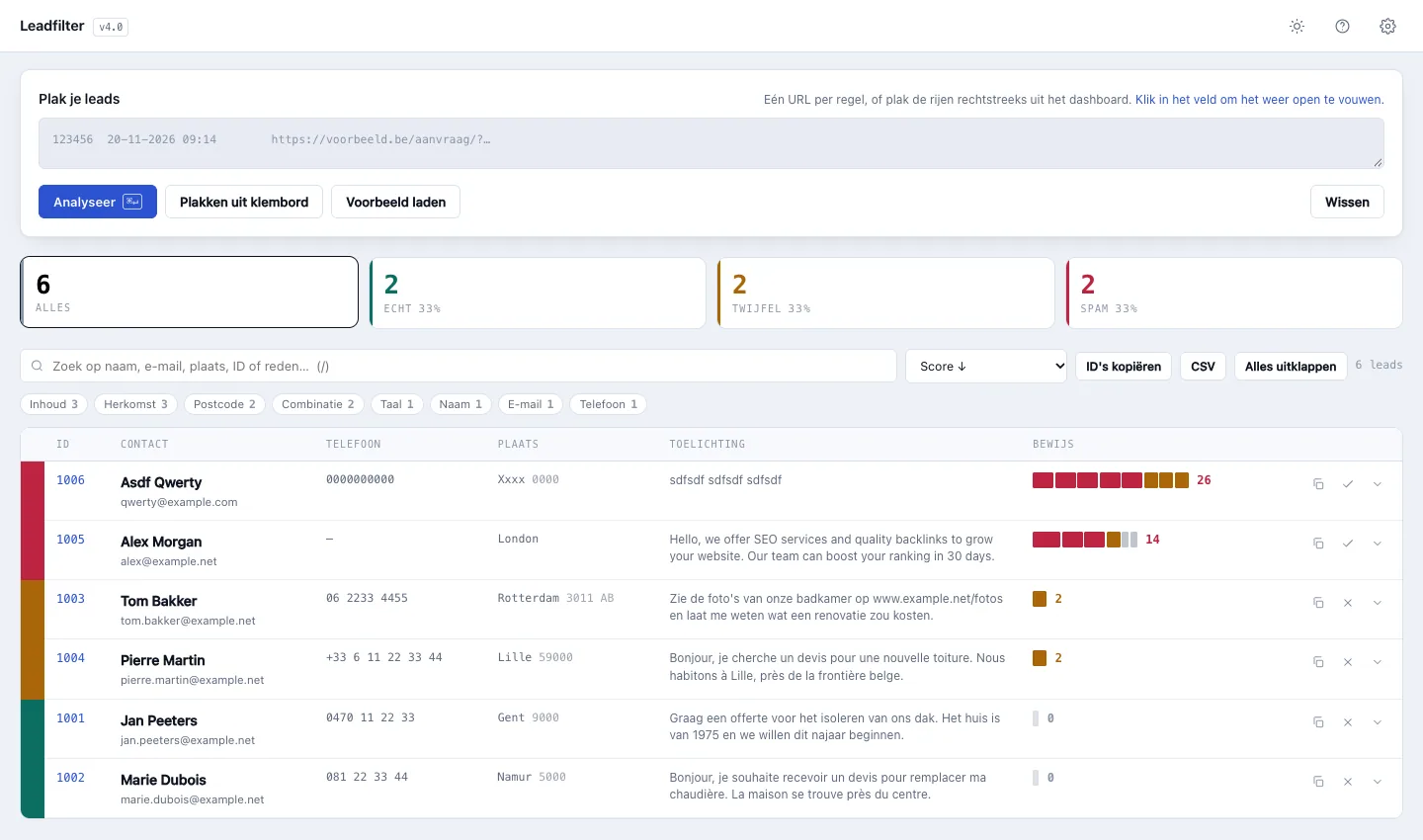
Demo with six made-up requests: spam at the top, genuine requests at the bottom, doubtful ones in between.
From jumble to plain text
The filter unpacks that long link into a neat row: name, email, phone, town and the message itself, in plain letters. Open a request and you see why it’s in its group: on the left what checks out, on the right what doesn’t, and how much each point weighs. Nobody has to trust a verdict blindly.
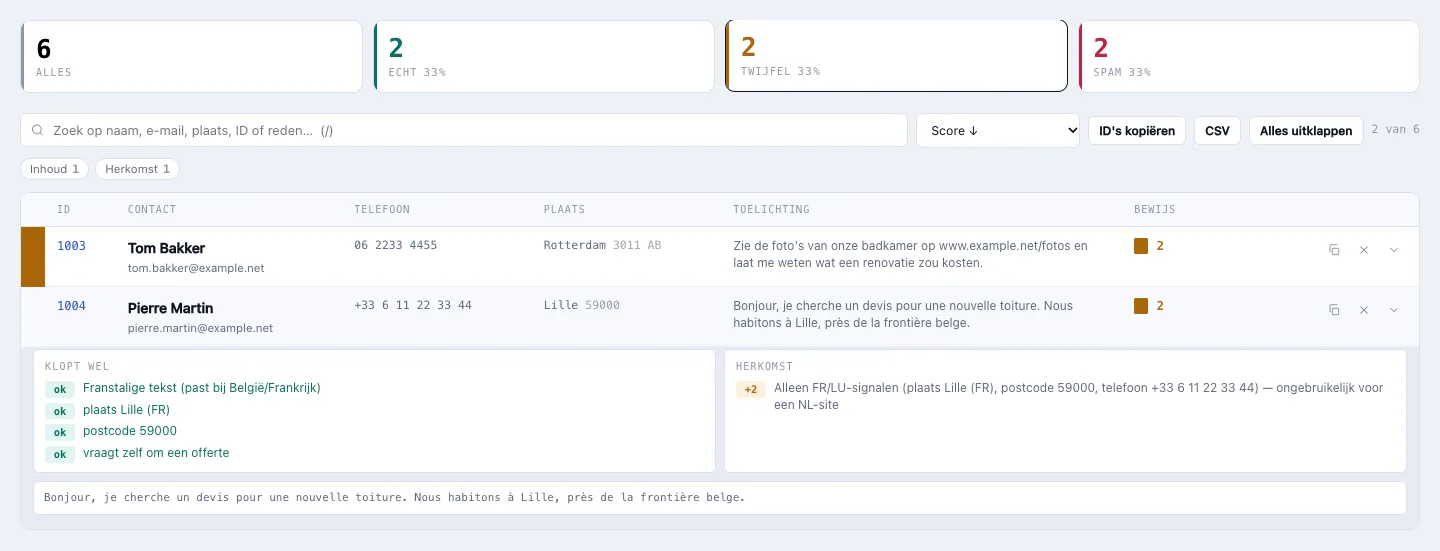
Everything checks out, but the request comes from France. A human decides that one. Demo with made-up requests.
What a colleague still does
The filter doesn’t decide alone. A colleague checks whether the requests are genuine, starts with the doubtful cases, and moves a request to real or spam if the filter got it wrong. The filter remembers that choice. Then the colleague sends the genuine requests on to the back office: you copy the numbers in one go, or download the list as a spreadsheet.
The result: what used to take a whole morning, sometimes even longer, now takes about half an hour.
Nothing leaves the computer
The filter is a single file you open in the browser. There’s no server and no account, and nothing goes out. Whatever it remembers, such as your settings and your last list, stays in your own browser.
Where it stands in November 2026
Colleagues still use it. It was made for one system and will never be public. Outside that system, it’s a bouncer without a door.
Fancy something like this for your business? Get a quote. Looking for a colleague rather than a supplier? Read my CV.